
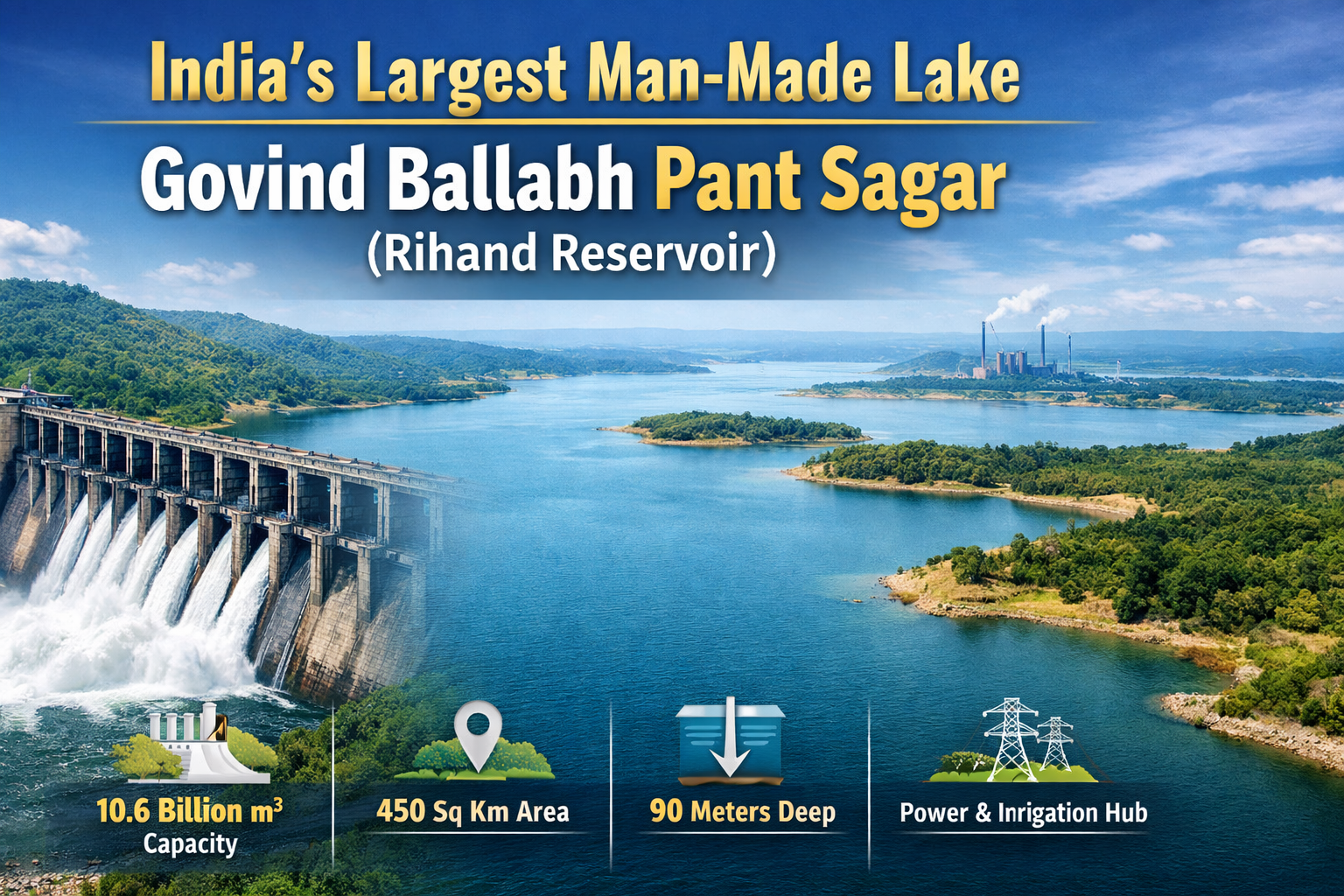
India is home to an extraordinary network of rivers, mountains, forests, and lakes. While many Indian lakes are natural, a significant number have been created by humans to meet the growing needs for water storage, irrigation, electricity generation, and industrial use. Among all such artificial water bodies, India’s largest man-made lake holds a special place due to its scale, strategic importance, and historical significance.
In this detailed guide, we explore Govind Ballabh Pant Sagar, also known as the Rihand Reservoir, which is officially recognized as the largest man-made lake in India.
Which Is the Largest Man-Made Lake in India?
India’s largest artificial lake is Govind Ballabh Pant Sagar, popularly called the Rihand Reservoir. It was formed as a result of the construction of the Rihand Dam.
This massive reservoir plays a crucial role in power generation, irrigation, industrial water supply, and environmental balance in northern and central India.
Location of Govind Ballabh Pant Sagar
Govind Ballabh Pant Sagar is located at Pipri in Sonbhadra district of Uttar Pradesh. A substantial portion of the reservoir also extends into Singrauli district of Madhya Pradesh, making it an inter-state water body of strategic importance.
The lake is built on the Rihand River, which is a major tributary of the Son River. The Son River itself is an important tributary of the Ganga, connecting this reservoir indirectly to the larger Gangetic river system.
How Was the Lake Created?
The lake came into existence due to the construction of the Rihand Dam. This dam is among the tallest concrete gravity dams in India.
Key Dam Specifications:
- Height: Approximately 300 feet
- Length: About 934 meters
- River: Rihand River (tributary of Son River)
The dam was designed primarily for hydroelectric power generation, but over time its utility expanded significantly.

Size, Area, and Depth of the Lake
What truly sets Govind Ballabh Pant Sagar apart is its enormous size.
- Total Storage Capacity: ~10.6 billion cubic meters
- Surface Area: ~450 square kilometers
- Maximum Depth: ~90 meters
Due to its vast area, the reservoir is often referred to as an “inland sea” of eastern Uttar Pradesh and northern Madhya Pradesh.
Why Is It Called Govind Ballabh Pant Sagar?
The reservoir is named after Govind Ballabh Pant, the first Chief Minister of Uttar Pradesh and a prominent Indian freedom fighter. Naming the lake after him was a tribute to his immense contribution to Indian public life.
The foundation stone of the project was laid in 1954 by Jawaharlal Nehru, India’s first Prime Minister.
- Construction Completed: 1962
- Inauguration Date: 6 January 1963
Purpose of the Rihand Reservoir Project
1. Hydroelectric Power Generation
The primary objective of the Rihand Dam and reservoir was to generate electricity. Power produced here supplies nearby regions and supports major industrial zones, especially in Sonbhadra and Singrauli, which are known as India’s energy hubs.
2. Irrigation Support
Water released from the reservoir is extensively used for irrigation in the lower regions of Uttar Pradesh and Bihar, supporting agriculture across thousands of hectares.
3. Industrial Water Supply
The reservoir provides cooling water to several thermal power plants in Sonbhadra and Singrauli. Its role is critical in sustaining coal-based power stations and heavy industries in the region.
4. Drinking Water and Urban Supply
The lake also contributes indirectly to drinking water availability for nearby towns and settlements.
Environmental and Ecological Importance
Over the decades, Govind Ballabh Pant Sagar has developed into a large wetland ecosystem. The reservoir and its surrounding areas support:
- Migratory and local bird species
- Aquatic biodiversity
- Seasonal fisheries
- Natural groundwater recharge
From an environmental perspective, the lake has become an important ecological zone, even though large dam projects also bring environmental challenges.
Social Impact and Displacement
While the project delivered substantial economic and infrastructural benefits, it also had social costs. During the construction of the dam and reservoir, many villages were submerged, leading to displacement of local populations. Rehabilitation and resettlement were major challenges during that period, a reality associated with many large dam projects in India.
Interesting Facts About India’s Largest Man-Made Lake
- It is the largest artificial lake by area in India.
- It supports one of the largest power-producing regions in the country.
- The reservoir spans two Indian states.
- Over time, it has transformed into a significant wetland ecosystem.
Conclusion
Govind Ballabh Pant Sagar, or the Rihand Reservoir, is not just India’s largest man-made lake—it is a symbol of post-independence India’s push toward infrastructure development, energy security, and water management. From powering industries to irrigating farmlands and supporting ecological balance, this massive reservoir continues to play a vital role in India’s growth story.
For anyone interested in Indian geography, dams and reservoirs, water resources, or infrastructure development, Govind Ballabh Pant Sagar stands as a remarkable example of human engineering on a grand scale.
Image Credit: Wikipedia
11 thoughts on “India’s Largest Man-Made Lake: Govind Ballabh Pant Sagar (Rihand Reservoir)”